I went back to teaching TESOL for a brief period during the holidays at end of 2017 and into early 2018. I wanted to compile a list of some of the best aspects of teaching English as a second language, and here it is.
1. The People
By far the greatest part of teaching English as a second language is the incredible people I have met along the way, the majority of which I am still in contact with, refer to the 5th point. From Natsuki, the Japanese language learning guru, who is rapidly working his way through most of the languages on the planet, to Camilo, the guitar playing Colombian, who has joined Paige, Byron and I for a few of our surf sessions, and even come down to the secondary school where I am currently working so that he could speak with the students in Spanish ( He still has the guitar I let him).
Working as an English second language teacher has given me a small taste of the different cultures that exist around the world and has enlightened me to the social norms from each of those places. I love listening to and watching students reactions as they discuss the different aspects of their countries. One of my favourites is when the Korean and Japanese students question the Brazilian students about the various antics that can happen at Carnival and other Brazilian festivals, while the Brazilians question the Japanese students about their massive school days. My other favourite story was the Brazilian girl who had just come in from the airport, hadn’t been briefed on the customs of either Australia or of the Japanese flat mates that she would be sharing a house with. She was dropped at the house, went in and was met by one of her new flatmates. She bounded up to the unsuspecting Japanese guy, who knew very little of Brazil or their culture, gave him a huge hug and a kiss on each cheek leaving the Japanese guy shocked, way out of his depth and not sure where to go from there, he didn’t even hug his parents goodbye when he left for Australia.
Something else that really struck me was the resilience that these students had. For instance, I was talking to one of my Brazilian students, Mai, and saying that I really admired how she had come half way around the world to live for a short period of time in Australia, one of the countries with the highest living costs on the planet, just so that she could learn English to improve her career prospects at home. At this point Mai said that at home she was a dentist with a comfortable standard of living, a nice apartment and a good car, and that yesterday she had worked on the Gold Coast as a taster. When I asked what she meant, she explained that she had been dressed as a chicken and was handing out free tasting portions for a restaurant on the coast. She said that when she returned to Brisbane in the afternoon, she had sat on the bank of the river and cried. But here she was back in classes the next day doing what it took to get through the course in order to give herself an edge. This is not an unusual story, I heard a lot of them during the brief period of time I spent working as an English language teacher and it gave me an appreciation for just how much hard work and dedication these guys and girls were putting in, and also how lucky we are in Australia.

Posing With Natsuki
2. Classroom Management
You cannot compare teaching English as a second language to the standard secondary classroom in this regard. I have never had TESOL students tell me that they haven’t brought a pen, or a book, you certainly don’t ask them to stop talking, and they aren’t likely to ask to go for a drink just as the listening activity is about to start. The vast majority of TESOL students want to be in your classroom, and they are there to learn as much as they can as quickly as possible. Classroom management comes down to making sure that you have enough interesting content to keep the students moving forward, and that you are confident with your material, as they will ask you many questions about the English language that as a native speaker we don’t really consider, they will not accept ‘because that is the way it is’ as an answer either, you need to know why you can’t buy two honeys or what a gerund is and where you would use it.
3. Excursions
When teaching adults excursions are a piece of cake, you don’t generally have to worry about parent permission notes, allergies or various contingencies plans. Excursions are generally a matter of preparing an activity, letting the school know, and you are ready to roll. We have done filming in the Queen Street mall, A walk through the history museum, where students had to listen to short films, recordings and presentations to answer questions. Scavenger hunts through the art gallery, and even a bus trip to Dream World.
4. The BBQ’s
The Friday afternoon BBQ’s were legendary and often consisted of a shopping trip on the way to either the Roma Street Parklands or The South Bank Pools. Students would organise the shopping and speak with the sales attendants, we would then take everything we needed and cook it up on the BBQ’s, where everyone would stand around helping with the cooking and chatting in English. This was a fantastic way to consolidate a solid of week of learning in a relaxed and friendly atmosphere. It was also a great way to farewell those students who had finished the course and were carrying on to the next stage of their journey.
5. FaceBook Friends
My facebook took on a life of its own as TESOL students all rushed to add me as a friend. This was a little confronting to start with, but once I came to realise that for many of these students they had been planning and saving for a long time to come on this adventure, and as their teacher for those few weeks or months I had became a significant part of that adventure. It is also a really intense time for the students as they are well out of their comfort zone, in a foreign country with a foreign language, culture and way of doing things and they really wanted to keep in touch with myself, the other teachers, and their classmates as a way of keeping the memories of their time in Brisbane alive. This has been amazing, as I now get updates from people all over the world. I can see what Yutaka is up to, which country Javier is visiting and how Jiro is going now that he is back in Colombia.
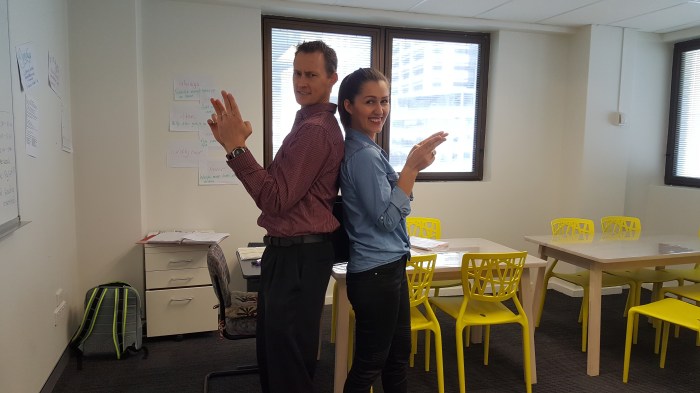
Posing with Alma
There are many other great aspects to teaching English as a foreign language but these are some of the best ones.


 blakeridler.com