13 October 2013
I have been studying Chinese on a fairly consistent basis since the beginning of 2009, and although I have a long way to go, I have managed to pick up a fair amount of vocabulary and have had some cracking experiences along the way. I have put together a few tips and pointers that I would like to have had when I first started on my language learning journey and I am sure that they will be of assistance to anyone out there who is looking for a place to start.
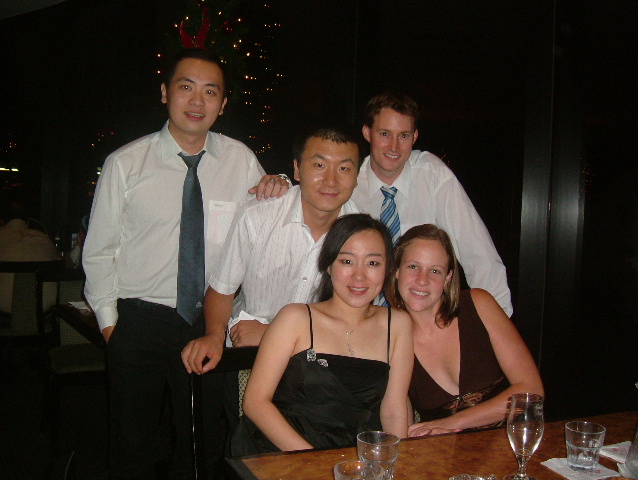
Song and Jiao’s Graduation Night
My journey : Making the decision to study Mandarin Chinese has been a massively rewarding and yet hugely challenging adventure. It all started one Sunday afternoon in Beenleigh markets when after a couple of weeks of hesitation on my behalf Tiff finally ordered me to ask the young Chinese couple who had a sunglasses stall there to help Tiff and myself learn Chinese. The conversation went something like this, ‘do you think they speak Mandarin Chinese?’ I asked Tiff,’ I have no Idea, Said Tiff, go and ask them’. ‘Do you think I should?’, ‘yes’, ‘and for Peat’s sake stop pestering me’ exclaimed Tiff. So I went and asked and was extremely happy to find out that yes indeed they spoke Mandarin and would be happy to meet up with Tiff and myself to do a language exchange, I went back and said all this to Tiff who then proceeded to ask what their names were and how we were to get in contact with them. I of course had failed to ask these trivial details, it’s a good thing Tiff is around or my Mandarin journey may have ended at this point.
We met up with Song and Peichen a few times for language exchanges and it turns out that although they are native Mandarin speakers they were not really trained as teachers, we were attempting to use a language book called Colloquial Chinese which makes logical leaps that I found difficult to keep up with, it also relied heavily on Pinyin and had very few characters. The language exchanges quickly became dinner between friends with Song and Peichen cooking one meet up and Tiff and myself cooking the next, in this way we were able to sample each other’s traditional cooking, so more of a meal exchange. We sat up for many hours listening to Song and Peichens childhood stories of China and sharing a few of our own experiences growing up in Oz. All the conversation was in English and over time Song and Peichen’s English pronunciation and listening comprehension became fantastic but I still didn’t know much if any Mandarin Chinese.
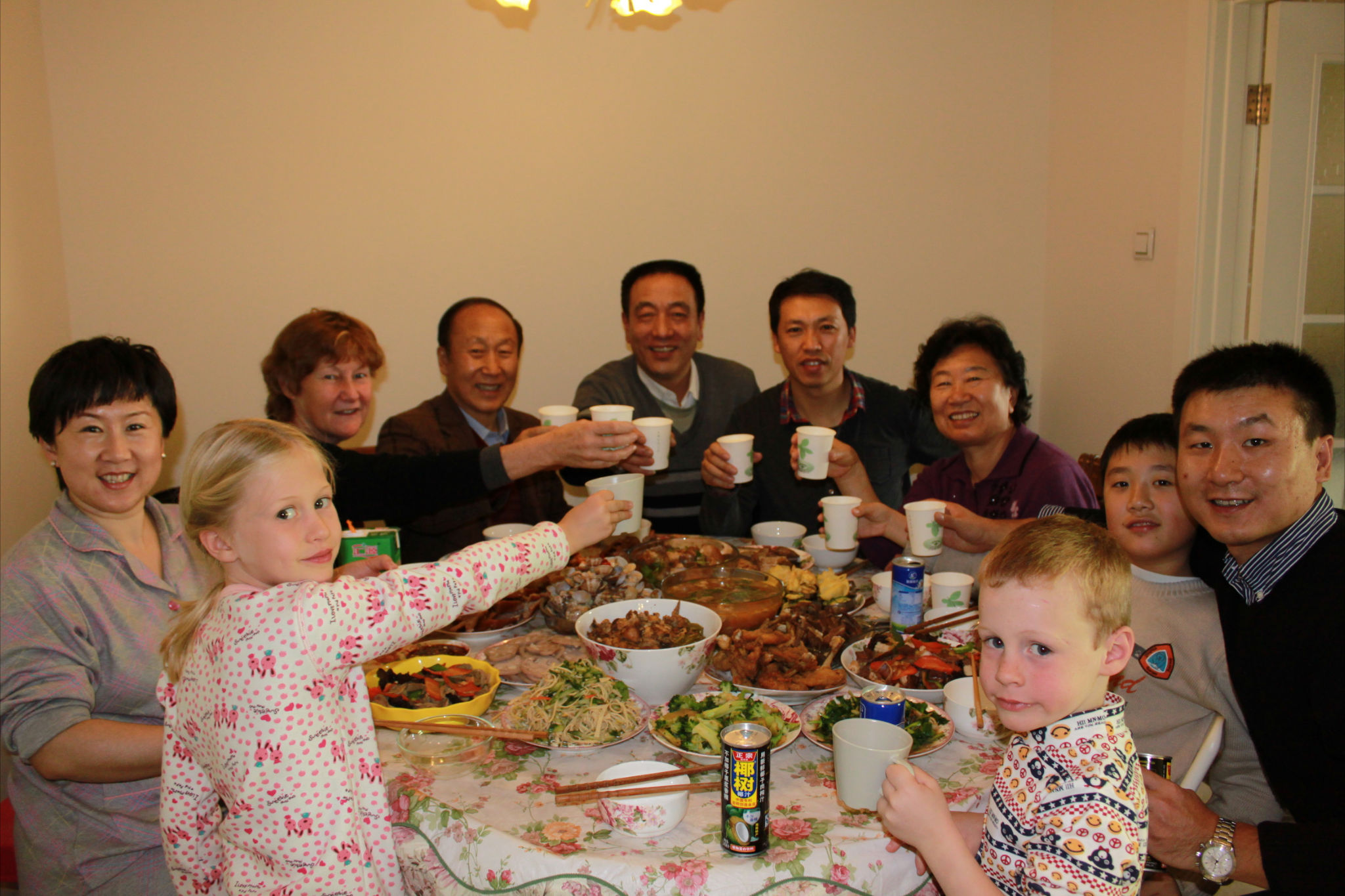
Paige and Byron do Spring Festival in Beijing
At this point Tiff and I did a bit more research and found that the Chinese Temple nearby held adult Mandarin classes, and so we tried again. This time we had a real live teacher by the name of Ariel and Ariel was using a Chinese Made Easy text book. The Chinese Made Easy series is straight forward and easy to understand, the first book contains characters and pinyin each chapter beginning with a short dialogue followed by a new words list that contains the English translation and then questions and simple sentences relating to the dialogues. Each text book has an accompanying CD that has the dialogues and short stories as read by native speakers which helps hugely with listing comprehension practice. As you move through the series there is less and less pinyin until by around book four the only pinyin is in the new word lists with the English translation.
We continued at the temple until the powers that be decided to double the price of the adult language classes, at that point Tiff and myself withdrew from the course and we enrolled Paige into the kids Mandarin school at the temple. I continued to use the Chinese Made Easy set to do self paced leaning at home and at the time of writing this I am part way through book number four.
Simplified Vs Traditional: I was speaking to a lady a few days ago at the Temple who was interested in learning Chinese and was hell bent on learning the traditional character system using the zhuyin method of pronunciation. This reminded me of myself when I first started out learning Chinese. There are many advocates of both styles of learning Chinese and you can generally delineate them depending on weather you are speaking to someone from mainland China or from Taiwan or Hongkong. The traditional characters are indeed very interesting and generally tell more of a story and in some cases look more like the things that they were originally depicted to look like than perhaps the simplified characters. I guess it comes down to this, if you are intending to go to mainland China then you will find that the majority of signage and literature is in simplified characters. The simplified characters are indeed easier to learn as in some cases there are a lot less strokes and the Chinese made easy text book simplified version also has some of the main traditional characters that you will come across beside their simplified version in the word list. Having said that, for the die heard naturalist or someone heading to Taiwan the Chinese made easy series also comes in a traditional character version.
Pinyin is a romanisation of the Chinese characters, it is used in mainland China and is a lot easier for westerners to learn than the zhuyin system used in Taiwan. Having said that as I have assisted first Paige and then Byron with their Chinese language homework over the last couple of years, I have learnt the zhuyin system by default, partly because that is the system the kids school at the temple uses but mainly because an A4 printout of it has been stuck to the refrigerator and the back of the toilet door for the last four years. Another major advantage of the Pinyin system is that it makes it very easy when typing on a western keyboard.
While I am on the subject there is no way to know how to say a Chinese character phonetically simply by looking at it, I was fascinated when Song and Peichen told me that although they use the same characters between Mandarin and Cantonese they are pronounced completely differently, leading to a situation where you can have two people sitting beside each other on the train who although they can share the same newspaper they cannot carry on a conversation. This means that you simply have to learn how each character is pronounced by rote and this is probably one of the main reasons that learning Chinese takes such a long time.
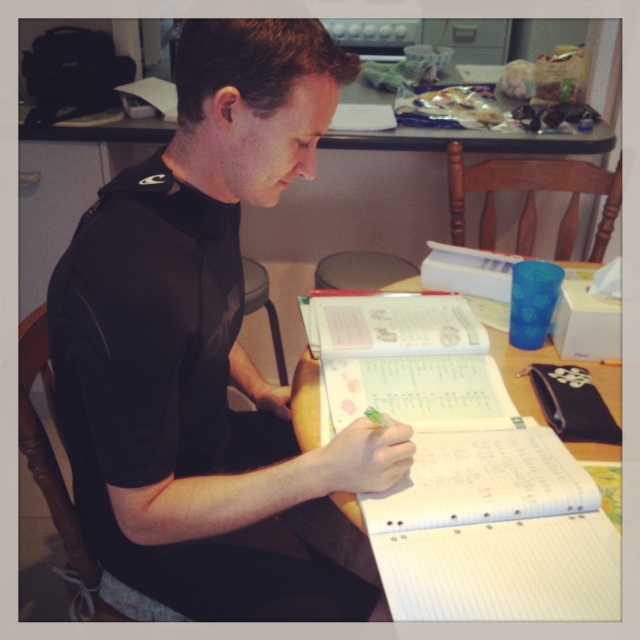
Studying Chinese Anywhere Anytime
A long term process: A couple of years ago I decided to get into surfing, I think it happens to many middle aged accountants based on the parody videos that are around. Once again Tiff came through with the goods, organising a couple of surf boards for us and forgoing her beloved bushwalking so we could go down to the beach and get pounded by the waves (which she hates, you are probably starting to understand why I married her, and wondering why she married me) week in week out until I eventually started to get the hang of first riding the whitewash, then paddling out through the breakers and learning how to duck dive, then chasing wave after wave until I finally managed to catch a couple of green ones. I guess what I am trying to say is that anything worth doing in life will take, time, dedication, hard work and a patient wife, Anthony Robbins is always saying that whatever you focus on on a consistent basis is where you will end up. Learning a language, any language and especially Chinese is like this, unless of course you are one of these people gifted with a photographic memory who can remember everything they have had for breakfast since the beginning of their life. If you are more like me and can barely remember what you had for breakfast yesterday then learning a language will take dedication. I have found that I study best in the mornings as my head is at its clearest (before the kids get up), I usually get up do some yoga and then study Chinese for around 45 minutes at least three times per week. The way I like to work it is to write out the story or dialogue from the Chinese made easy text, listen to it through a couple of times and then translate the words that I don’t know into English. What I tend to do is write the Chinese character on the middle line, put the pinyin and tone marker above the character and the English translation below the character. These days if I know the pinyin and English then I will only put the tone marker above the character. This is probably a good point to mention that Chinese is a tonal language in that the same word with a different tone will have a different meaning also two words together can have a different meaning to the individual words separately, don’t stress you will figure it out as you go.
Listen, Listen, Listen: I can’t stress this enough, one of the hardest parts I have found when it comes to learning a language is the ability to interpret what someone is saying. In fact I have a hard time interpreting what people are saying in English, sometimes Tiff will look up at me from whatever she is doing and launch into a sentence and it takes me a good few seconds to work out A that she is talking to me and B what it is that she is actually saying. When it comes to listening to a foreign language you can multiply that feeling by about 10,000 times. Having studied languages for a number of years I have discovered that the ability to speak the language does not necessarily mean that you can interpret what is being said to you. This is why it is imperative to listen to your target language as often as possible. I have found that it is more efficient if you can see the words that are being spoken written down at the same time
I mentioned at the beginning of this blog that learning Chinese has been a massively rewarding journey and feel I should elaborate on some of those rewards. It has come to my attention over the years that when people make a decision and get started on a particular path then opportunities that they wouldn’t have thought possible suddenly become available to them. For example, Tiff, Paige, Byron and I were strolling through the Burleigh shops a few months ago and we discovered a little Italian Deli tucked away in the back streets. As we were having a discussion with the lady who worked there it came to light that she had been recently made unemployed and instead of wallowing in self pity she had decided to take a course in Italian, at the course she met the owner of the Italian deli and the rest is history. Our own story follows a similar grain, as I mentioned previously by taking that first step we met Song and Peichen who have gone on to become really close friends of ours and we have shared some awesome experiences including our trip to Beijing for Song and Peichens wedding and you can read about that in my blog here if you are keen. Paige and Byron also went with Song and Peichen to Beijing only this time it was for Spring Festival, which is a bit like our Christmas and New Year all rolled into one 15 day long party with fireworks and food a plenty. These are just a couple of examples of some of the cool things that have come about due to our decision to learn Chinese and I can assure you there are many other most excellent adventures and interesting people that we have met along the way.
The best piece of advice I can give to anyone looking to learn Chinese is to just get started, good luck and have fun.


 blakeridler.com